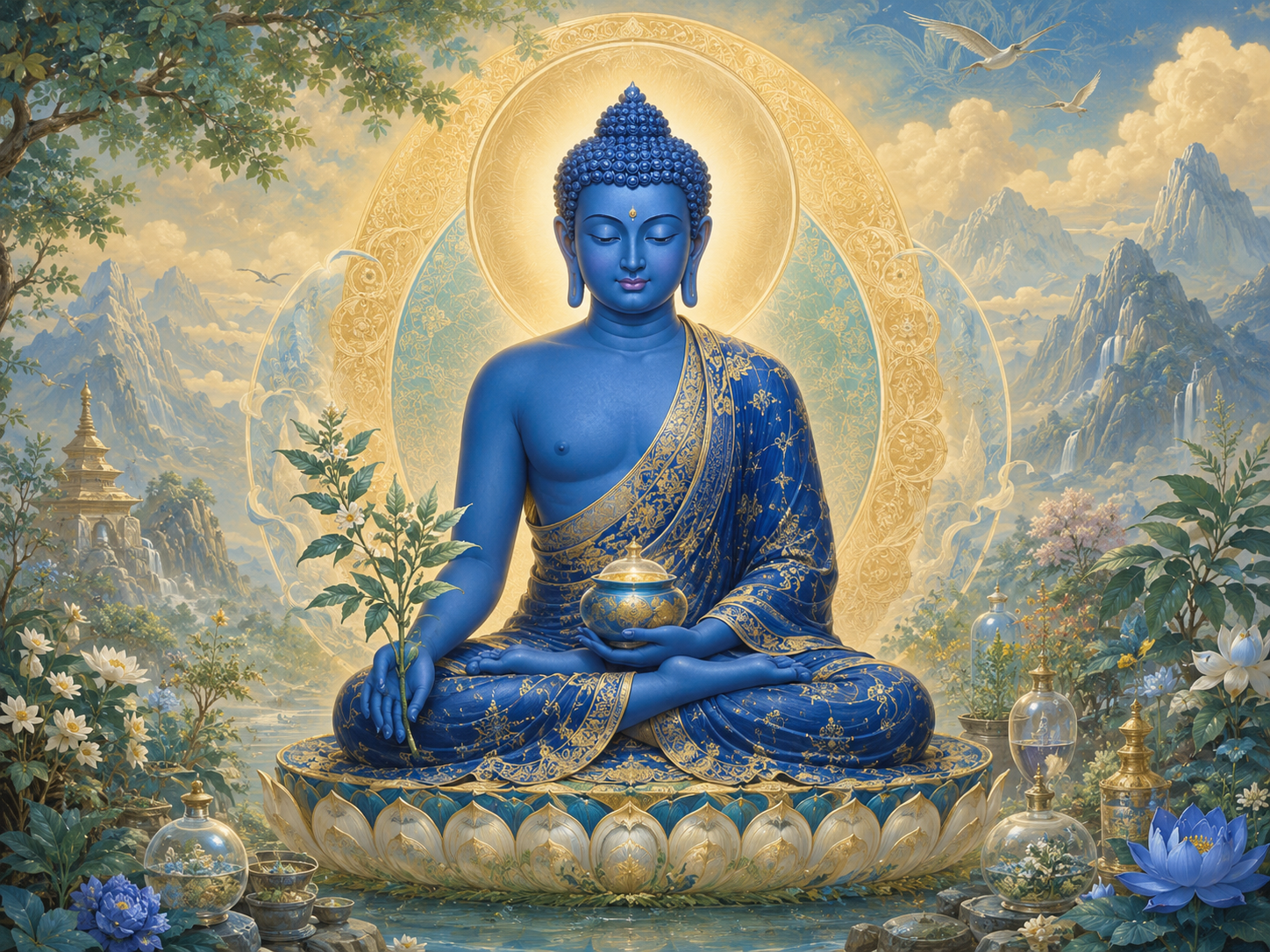
The Twelve Great Vows of the Medicine Buddha
The First Great Vow
I vow that when I come into the world and attain Anuttarasamyaksambodhi, my body will radiate light that illuminates countless worlds with brilliant and enchanting splendor. My body will be adorned with the 32 secret marks and the 80 wondrous qualities, and I will lead beings to enlightenment.
The Second Great Vow
I vow that when I come into the world, my body will become like vaidurya (lapis lazuli). From within and without, it will be permeated with light. It will be pure, immaculate, radiant, majestic, and free from all flaws and impurities. My radiance and benevolence will rise high, and my entire being will become a source of goodness and peace. An aureole like blazing fire will adorn my body. Its brilliance will surpass the light of the sun and moon. All sentient beings suffering in darkness will instantly be freed from ignorance and begin acting according to their compassionate aspirations.
The Third Great Vow
I vow that when I come into the world and attain Bodhi, through immeasurable and boundless wisdom, I will ensure that all living sentient beings obtain everything they lack. They will know no deprivation.
The Fourth Great Vow
I vow that when I come into the world and attain Bodhi, I will ensure that all sentient beings who follow false paths will peacefully, confidently, and harmoniously establish themselves on the spiritual path.
The Fifth Great Vow
I vow that when I come into the world and attain Bodhi, immeasurable numbers of beings who follow the Dharma I teach will accept the vows of the three disciplines: avoiding evil, cultivating goodness, and purifying the mind, that they lack. Even if they have committed offenses or transgressions, upon hearing my name they will regain purity and will not be reborn in lower realms of existence.
The Sixth Great Vow
I vow that when I come into the world and attain Bodhi, all sentient beings who are weak in body, lacking sensory organs, ugly, deformed, repulsive, foolish, blind, deaf, mute, twisted, hunchbacked, crippled, lame, paralyzed, leprous, insane, or afflicted by all kinds of illness and suffering, will gain flexibility, beauty, swiftness, intelligence, and wisdom merely by hearing my name. All their faculties will become whole, and they will no longer suffer from disease.
The Seventh Great Vow
I vow that when I come into the world and attain Bodhi, all sentient beings who suffer from illness and misery, who cannot free themselves from suffering, who have no refuge, no protection, no doctors, no medicine, no relatives, no family, no food, who are poor and burdened with countless hardships, will instantly be freed from all illness as soon as my name reaches their ears. Their bodies and minds will abide in infinite peace and joy, their families and loved ones will enter a world filled with compassion and love, they will prosper and possess all necessities, and they will also attain the highest Siddhis.
The Eighth Great Vow
I vow that when I come into the world and attain Bodhi, all women who are scorned, unhappy, exhausted, and suffering will be liberated from their pain and attain masculine Siddhis.
The Ninth Great Vow
I vow that when I come into the world and attain Bodhi, I will ensure that all living sentient beings escape the snares of Mara’s demons and become free from deceptive views and teachings, doubts, and anxiety. I will guide them gradually toward compassionate spiritual practices, and they will discover Supreme True Bodhi.
The Tenth Great Vow
I vow that when I come into the world and attain Bodhi, all sentient beings who are imprisoned, tortured, awaiting execution, enduring unbearable suffering, violence, and humiliation, condemned, sorrowful, frightened, grieving, and longing, whose bodies and minds are constantly in pain, will be liberated from all sorrow and endless suffering merely upon hearing my name, through the greatness of my virtue and the power of spiritual bliss.
The Eleventh Great Vow
I vow that when I come into the world and attain Bodhi, all sentient beings who suffer from hunger and thirst and commit harmful acts because of poverty and hardship will hear my name as a refuge and uphold it. Then I will nourish and fill their bodies with miraculous drinks and nourishing food, and through the flavors of the Dharma I will lead them into peace and boundless joy, establishing them firmly within it.
The Twelfth Great Vow
I vow that when I come into the world and attain Bodhi, all sentient beings who are poor and without clothing, who suffer day and night from mosquitoes, insects, heat, frost, wind, dampness, and harsh weather, will receive miraculous garments as soon as they hear my name, focus their thoughts upon it, accept it, and practice it with precision and devotion. Thus they will gain jewels, crowns, fragrant floral ointments, drums, and musical instruments. They will possess every possible and impossible gift, talent, and ability their hearts desire.
In the name of the Healing Enlightened Deity, the Radiance of Lapis Lazuli, I bestow these subtle and miraculous Twelve Vows.
When Buddha Bhaishajyaguru attained supreme and perfect enlightenment through these vows, he beheld all sentient beings suffering from various illnesses and afflictions. Some suffered from exhaustion, weakness, emaciation, or yellow fever; others from sorcery, spirits, or poisons: such as snakes and serpents. Some died young, while others died prematurely through accidents. He wished to dispel all their sicknesses and suffering.
Therefore, the Noble One entered the samadhi for the elimination of the suffering of all living beings. From his Ushnisha, he emitted a marvelous radiance of brilliant light and recited this great dharani:
NAMO BHAGAVATE BHAISHAJYA GURU VAIDURYA PRABHA RAJAYA TATHAGATAYA ARHATE SAMYAKSAMBUDDHAYA.
TADYATHA OM BHAISHAJYE BHAISHAJYE MAHABHAISHAJYE BHAISHAJYE RAJASAMUDGATE SVAHA.
As he uttered this mantra while shining with the light of lapis lazuli, the earth trembled and was illuminated. All the suffering and illnesses of beings subsided, and they experienced peace and happiness.
Long Mantra
NAMO RATNA TRAYĀYA / NAMO BHAGAVĀTE / APRATIHATA / BHAIṢAJYAI-RĀJĀYA / TADYATHĀ / OṀ SARVA TATHĀGATA HŪṀ / GHUME GHUME / IMINI MIHI / MATI MATI / SAPTA TATHĀGATA / SAMĀDHYA DHIṢTHITE / ATE MATE PĀLE PĀPAM ŚODHANI / SARVA PĀPAM NAŚAYA / MAMA BUDHE / BUDHO TATAME / UME KUME / BUDHAKṢE TRAPARI ŚODHANI / DHAMENI DHAME / MERU MERU / MERU ŚIKHARE / SARVA AKĀLA ṀṜTYU NIVĀRANI / BUDHE SUBUDHE / BUDHE ADHIṢTHITENA / ADHIṢTHITENA / RAKṢANTUME / SARVA DEVA SAME ASAME / SAMAN-VĀHARAN-TUME / SARVA BUDDHA BODHISATTVA / ŚAME ŚAME / PRAṢAMAN-TUME / SARVA ITYU PADRĀPA / VYADHAYAḤ PŪRANI / SUPŪRANI / PŪRAYAME / SARVA ĀŚĀME / VAIḌŪRYA PRATIBHĀSI SARVA PĀPAM KṢAYAM KARI SVĀHĀ / OṀ BHAIṢAJYA BHAIṢAJYA / MAHĀ BHAIṢAJYA BHAIṢAJYA / SAMUDGATE SVĀHĀ
The Medicine Buddha
In the Mahayana Buddhist tradition, Bhaishajyaguru — the Medicine Buddha — is the embodiment of healing, light, and boundless compassion. His name means “The Medicine Master of Lapis Lazuli Radiance,” and His vow is absolute: to heal the suffering, illness, and spiritual pain of all sentient beings.
For many Buddhist practitioners, turning to the Medicine Buddha — through mantra, prayer, or visualization — becomes a sincere refuge during times of illness or suffering. Yet the true practice is not experienced only in moments of crisis; it represents a luminous ideal, the aspiration of pure Bodhicitta: awakened compassion in action, a life renewed through goodness and devotion to the happiness of all sentient beings.
The paradise of the Medicine Buddha, depicted in Tibetan medical tantras as the garden of herbs and healing substances called Tanaduk, reflects a perfect universe in which there are remedies for every affliction, where every suffering is answered, and every being has the opportunity for liberation. The Buddha himself said:
“For every sentient being, as long as it exists within this world system, there is a path to liberation.”
The Medicine Buddha teaches that even an ordinary person possesses an extraordinary capacity for healing. This ability is attained by recognizing the suffering of others as one’s own, suffering as they suffer, and feeling unity with them. Cultivating such feelings develops a warm and caring heart filled with compassion — an essential part of the Buddhist Path.
Only then can one mobilize the boundless healing powers hidden within the depths of consciousness. In fact, it is taught that illness and suffering can be liberating, because they allow us to experience our interconnectedness with other beings while confronting us with impermanence and mortality.
A Story About an Abbot
There is a story about a monastery abbot who embodied Bodhicitta and possessed the siddhi of miraculous healing. One day, while addressing his students, he suddenly cried out in pain. When the lamas asked what was wrong, he replied that a dog outside was being beaten.
The monks went out and found an angry man chasing a dog with a stick. When the man was brought before the abbot, the abbot removed his robes to reveal his back. In the exact places where the dog had been struck, there were fresh cuts and bruises on the abbot’s body. It is precisely this kind of unity with other beings, and this depth of compassion cultivated by the ideal healer, that practitioners aspire toward.
Compassion and Healing
Buddhist tradition describes the Medicine Buddha as the ideal physician and emphasizes that the greatest healing powers lie in compassion rather than in secret rituals or interventions.
It is very important to respond to another being’s suffering in a form that is accessible and understandable to that being. Compassion may appear as medicine, advice, wrath, comfort, or sometimes silence. Therefore true compassion cannot be separated from wisdom, just as Buddhist practice cannot be separated from compassion and contemplation of the suffering of all beings.
One must cultivate compassion without concepts or categories — responding to suffering with a living heart, answering as though the suffering being were one’s own child, remembering that every sentient being has, in some lifetime, been our mother and cared for us in our hour of suffering. The Medicine Buddha teaches unconditional compassion, without dividing others into those worthy or unworthy of healing.
The great master Dilgo Khyentse taught:
“When you release the mind’s grasping, infinite compassion naturally arises.”