Sangha is one of the Three Jewels of Buddhism, together with the Dharma and the Buddha. It is the community that follows the Dharma and aspires toward Enlightenment. It includes both monastics and lay practitioners, and even yogic hermits.
Why is the community considered equal in importance to the Buddha and His Teaching?
First of all, Sangha reveals Buddhism as a living, breathing, and evolving spiritual Tradition—a Teaching that adapts and develops with the changes of time and the world, rather than merely a collection of philosophies or methods. Buddhist ideas and values are not meant only to be contemplated; they are meant to be lived and embodied. The most fertile ground in which the fruits of practice can flourish is the community. One may think endlessly about Śūnyatā (Emptiness), non-attachment, or Bodhicitta on a theoretical level, but until the word becomes flesh and compassion responds to actual beings, these remain only mental images—sophisticated, exotic concepts.
In a certain sense, no practice involves only ourselves. Beyond the members of the sangha, we are connected through countless relationships and interdependencies with other beings. When we bow before the Buddha or make offerings during a Ganapuja, our ancestors are present, as are our beloved and less-beloved neighbors, visible life forms, invisible beings, local protectors, personal deities, spirits, beings with whom we share karmic connections, karmic debtors, and so on. In the broadest sense, all of them are part of the sangha during practice, and we seek Enlightenment for the benefit of all of them.
All sentient beings are fellow travelers aboard the same vessel crossing the ocean of samsara. Whether they know it or not, all are journeying through this vast cosmic voyage toward their innate luminosity. Some may already aspire toward Enlightenment; for others, that aspiration may not arise for many eons yet. It is said that when one being attains Enlightenment, a thousand others awaken along with them. For the sake of all beings, we must strive to practice. Yet it is essential that the understanding of Bodhicitta not remain merely words or an abstract idea—it must take on a concrete, human form. As practitioners, we must do something tangible for the realization and Enlightenment of others.
Pure Friendship
One of the Tibetan Buddhist masters who understood Westerners and the complexities of the Western psyche particularly well, Chögyam Trungpa, said:
“Sangha is a community of people who have every right to cut through your confusion and feed you with their wisdom, and who also have every right to display their own neuroses and allow themselves to be completely seen by you. Friendship within the sangha is a kind of pure friendship—without expectations, without demands, yet deeply fulfilling.”
What kind of relationship can be called pure? It is a connection in which there is no room for habitual, learned, and artificial behavioral patterns. In the Theravāda tradition this is known as kalyāṇa-mitta—noble friendship—where people are given permission to tell you the truth even when you do not wish to hear it.
Sangha is not a family in the conventional sense, because its members are not bound by blood ties, inherited roles, expectations for the future, or unspoken obligations. Members may come from entirely different backgrounds, professions, and social classes.
Patrul Rinpoche taught that although relatives care for us, they are not our ultimate refuge. They teach us how to survive, adapt, earn a living, raise a family, and avoid bringing shame upon ourselves—but none of this is directly related to Liberation. He humorously compared it to teaching a little rat how to gather food and avoid traps in order to become a successful rat—faster, smarter, and more efficient than the others.
Parents, children, spouses, and loved ones often seem to be the most important people in our lives. They attempt to weave an illusion of permanence and security, as though impermanence and death did not exist. Yet spiritual practice seeks to tear away that net of imagined security. Family often wishes us to remain as we are because they know us through our familiar identity. Out of attachment to relatives, we may fear change, cling to old habits and self-images, or fail to devote ourselves fully to practice. Sangha encourages transformation, even when it is uncomfortable, and helps us move beyond fixed identity.
Nor is Sangha simply friendship. Friendship often revolves around pleasant companionship, shared interests, support, or enjoyment. While these may also exist within Sangha, they are not its primary purpose. Community here is oriented toward awareness, spiritual growth, and a willingness to help one another recognize not only strengths but also the obstacles that prevent maturation.
Members of a sangha share knowledge, skills, traditions, offerings, rituals, and more. Sociologists sometimes describe such exchanges of values, traditions, and knowledge as a form of horizontal transmission. If blood-related groups are united by the goal of continuing a lineage and unconsciously transmitting patterns of behavior and karmic imprints, Sangha is united by the aspiration to grow and transform karmic seeds.
The bonds of Sangha cannot be measured by the ordinary concepts of business, utility, reciprocity, or personal gain. One does not ask, “What will I get from this?” Instead, one is taught to give—simply to give—the very best one has, without expectation of reward.
Shared Values
Within Sangha it is far easier to cultivate virtues and accumulate merit because members share an understanding of what is beneficial and what is harmful. When one strays from the path, Dharma brothers and sisters can help one avoid mistakes. Collective practice generates vastly greater merit and contributes to the happiness of countless beings.
We live in an age of value pluralism. Modern people can choose from countless worldviews, religions, philosophies, and lifestyles. This provides a degree of freedom unprecedented in recorded history. Yet without a common orientation or hierarchy of values, it becomes increasingly difficult to distinguish what is wholesome from what is unwholesome.
A dangerous attitude often emerges: relativism, the belief that all values and distinctions between right and wrong are merely social constructs that change with circumstances and time. From a Buddhist perspective, this amounts to a denial of one of the primordial wisdoms—the Wisdom of Discernment. Without cultivating discernment, spiritual development is impossible. One cannot even place a foot upon the path if one cannot distinguish between phenomena that lead toward liberation and those that lead toward suffering.
Sangha rests upon the assumption that there are universal directions of human maturation: greater awareness instead of unconsciousness, greater compassion instead of indifference, greater truth instead of self-deception. People may differ in character, experience, and opinions, but they share agreement about the direction of growth.
Noble Sangha and Hermit Yogis
In Buddhist tradition, Sangha is not defined merely by physical proximity to other people. Therefore, even a hermit yogi living alone in the mountains remains part of the Sangha. The yogi’s life is based on the same teachings, the same lineage, and the same goal as those of other practitioners.
Every practitioner is connected through countless relationships: teachers who introduced them to the Dharma, lineage holders, monks who spent countless hours preserving texts, artists who create sacred Dharma objects, travelers who transport teachings, and all those who contribute to the path.
Even when living alone in a cave or wilderness, the yogi carries these relationships within. Tibetan tradition often says that the hermit meditates not only for himself but for all beings. His solitude thus becomes a special form of service to the Sangha and to the world.
From the Buddhist perspective, the true Sangha is not merely external. There is also the Ārya Sangha—the Noble Sangha—consisting of those who have directly realized the nature of reality. Membership in this Sangha does not depend on whether one lives in a monastery, a city, or a Himalayan cave. It is defined by realization.
The famous Tibetan yogi Milarepa spent much of his life in mountain caves. Yet he was not merely part of the community—he became its very heart, inspiring an entire nation to pursue the Dharma.
Vajra Brotherhood and Sisterhood
The great Dzogchen master Chögyal Namkhai Norbu described Sangha as a connection deeper than simply following the Buddha’s teachings or observing the same Vinaya rules.
In Atiyoga, the master introduces the student to the nature of mind and reveals rigpa. This primordial luminous awareness is regarded as the root, foundation, path, and fruit of Enlightenment. Members of the Sangha are called vajra brothers and sisters because their true nature is identical: primordial awareness itself. The ultimate purpose of all communal practice is to cultivate and realize this state.
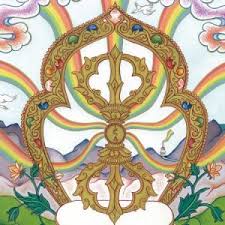
The vajra—the mythical weapon of Indra—symbolizes that which is beyond duality, indestructible, and of the nature of emptiness and luminous clarity. Vajra qualities include being indestructible, incorruptible, unassailable, unchangeable, undefiled, invincible, and beyond limitation by beginning, ending, or change.
In this sense, the bond between vajra brothers and sisters is so profound that it cannot be destroyed. No ordinary human relationship, however pleasant or joyful, can compare to it. Failing to appreciate this connection becomes an obstacle to practice and realization. It is a bond that cannot truly be lost or forgotten.
Sangha as a Mirror
True practice and Enlightenment do not occur in isolation from the world but in relationship with it. Other people constantly reveal aspects of ourselves that we cannot see. Like a mirror, the community shows us the fruits of our meditation. Have we truly learned not to become angry? Can we release habitual patterns such as comparison, pride, or competitiveness?
Moments of boredom, sadness, or irritation are often the best opportunities to examine the state of mind. Can we rejoice in another person's spiritual accomplishments as though they were our own? Can we carry another’s happiness as our greatest achievement and bear another’s suffering upon our shoulders?
Simply being with others—listening, speaking, resolving conflicts, letting go of ego, cultivating compassion—is itself one of the most important forms of practice.
This is why Buddhist tradition regards Sangha as one of the Three Jewels, alongside the Buddha and the Dharma. Not because the community is perfect, but because without other people it is extremely difficult to see ourselves clearly. Alone we may meditate, study, and reflect, but it is relationships that reveal whether our understanding has become a living reality.
As Thich Nhat Hanh said:
“The Sangha is your practice.”
Practices for Cultivating Sangha
Consistently participate in the community, not only when you feel inspired or when everything is going well.
Cultivate noble friendship: ask for feedback, inquire about your blind spots, and listen rather than defend yourself.
Transform conflicts within the community into opportunities for practice by cultivating humility and patience.
Engage in selfless service, even through simple acts such as sweeping the community hall.
Commit yourself to truthfulness: speak honestly, avoid resentment, gossip, and passive aggression; speak only when necessary.
Practice muditā (sympathetic joy): sincerely rejoice in the success and progress of others.
Regard every member of the community as a teacher capable of sharing wisdom.
Respect the practice of others; do not criticize the pace or achievements of another's path.
Avoid sectarianism and comparisons with others.
Cultivate shared values and remind one another of them.
Above all else: COMPASSION