Jacob Winkler and Eva Hofinger
Editor: Andy Lukianovich
Translated from English into Russian by Olga Tsvetkova

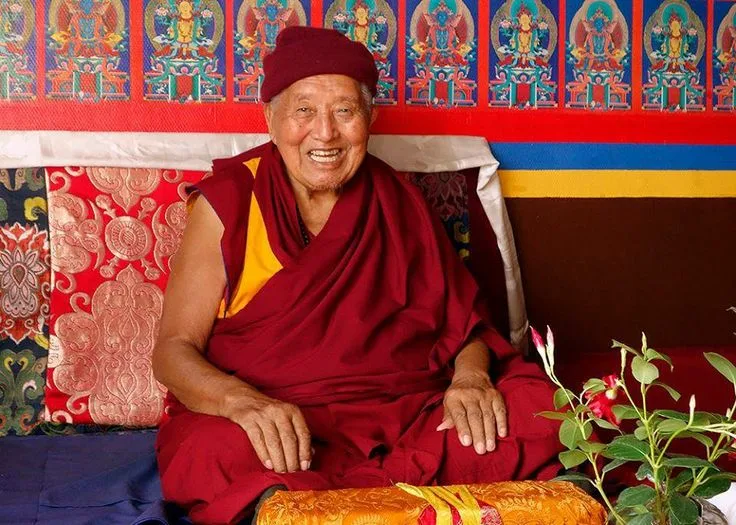
Today, Lopön Tenzin Namdak Rinpoche is the principal teacher of the Bönpo tradition. Since leaving Tibet, he has worked continuously on the problems of the survival and preservation of the Bön tradition. He has visited Merigar many times and is even depicted in the Temple of Great Liberation at the Merigar Gompa.

The ASIA project supports his activity and provides sponsorship assistance to young monks and orphans studying at his monastery.

Last October, Eva and I visited Triten Norbutse — Lopön’s monastery in the Kathmandu Valley, not far from the great stupa of Swayambhu. Before the interview, together with others, we spent several days receiving teachings on trekchöd and thögel from the Oral Transmission of Zhang Zhung — the Zhang Zhung Nyen Gyud.


Jacob: I am impressed by how directly and simply you teach Dzogchen: first explaining the practice of concentration, then the search for the natural state, and finally the practices of trekchöd and thögel. I have never heard Tibetan teachers give teachings in such a direct way. Why do you do this?

Lopön Tenzin Namdak Rinpoche: According to our tradition of Dzogchen teachings, the natural state has two aspects: clarity and emptiness.

Abiding in a state without thoughts or sensory perception, in the state of hedawa, a state free from the activity of the mind, is a common basis for Tantra, especially Mahamudra. In ancient times, some schools regarded this as the Madhyamaka view. But in the Dzogchen view there is something more than hedawa: besides it, clarity is spontaneously present in the natural state. One must realize both. For if one practices only hedawa, how is one to live? We hear, see, taste, touch — all of this exists, and something must be done with it.

In Dzogchen, through trekchöd, you are introduced to the natural state. Reflections arise from emptiness, and thögel practice serves as evidence of this.

Once you have become familiar with the visions and experiences of thögel, you will be able to integrate them with ordinary life without difficulty: everything appears from emptiness, abides in emptiness, and liberates into emptiness. But if you separate emptiness and clarity, you will not be able to attain the true Dzogchen view.

The practice of developing your intention to benefit all sentient beings is not a waste of time, but according to Dzogchen texts, such a practice is not complete. Therefore, I always try to teach Dzogchen as openly as possible, explaining either briefly or in greater detail, as time allows.

We may not know who is ready to receive Dzogchen teachings. Many try to reserve them for Tibetans, saying that people in the West do not practice and should not be taught. I, however, tell many teachers that it is entirely appropriate to give teachings to people who are truly devoted to Dzogchen, and that they need authentic teachings.


Jacob: Listening to your teachings, I understood that the Zhang Zhung Nyen Gyud contains the whole essence in a very condensed form.

LTNR: Yes.

Jacob: These teachings seem to me not as elaborately developed as the Dzogchen teachings of the Buddhist tradition. Nevertheless, everything is there.

LTNR: Yes, certainly, everything is there. If we had more time, we too could give the teachings in greater detail.

Jacob: Then conditions should be created so that you have that opportunity. How many weeks would it take?

LTNR: Years, years! One can teach for a very long time, explaining and commenting on everything in detail.


Jacob: In the West, some people find ideas about Dharma protectors rather strange. They think this is Tibetan mysticism or superstition.

LTNR: Yes! But that is a somewhat different topic. Whether you resort to protector practices or not, the activity of the protectors still exists.

Usually I say: if you are interested in Dharma protectors, that is good; if you are not interested, that is also good. After all, it is impossible to do everything! The Bönpo have so many practices, Dharma protectors, deities, mantras, and so on.


Jacob: What is the most necessary practice if one wants to practice Dzogchen? Which related practices truly need to be done?

LTNR: Guru yoga! Guru yoga will protect you from everything.

If devotion is very strong, it is good protection; it gives blessing. Everything can come from guru yoga. Nothing else is needed.

Jacob: In one of your teachings, you said that it is important to regularly perform protector practice.

LTNR: That is if one has the wish to do something of that kind, but the most important thing is guru yoga. It is the only thing that matters. It can do everything.


Jacob: On the one hand, for a Buddhist, even if he is a beginner in the Bönpo teachings, it is easy to understand them because you speak about many concepts that are very familiar from Buddhist teachings: for example, karma, bodhicitta, liberation, buddhas, and so on. On the other hand, all the names of Bönpo deities and protectors are new, and there are also new terms. Therefore, at times I think that I would like to engage in the practice of Dzogchen teachings of the Bönpo tradition, but without going too deeply into other Bönpo teachings. Would such a practice be complete?

LTNR: Certainly. If you have already received empowerment from another tradition, you should not lose faith in it. There is nothing good in that.

But Dzogchen includes everything. There is no need to become familiar with all the deities and so on. But if you are interested, that is not bad.

The main thing is to practice Dzogchen as much as possible. Which one — it does not matter. There is no difference between Bönpo Dzogchen and the Dzogchen of the Nyingma school. Nature is nature, and emptiness is emptiness everywhere. But one should not confuse different concepts of emptiness, such as, for example, the emptiness of the Madhyamikas and the emptiness of the Cittamatrins. Everyone speaks of emptiness, but in each school emptiness has different qualities.

Jacob: Different definitions?

LTNR: Yes, their definitions are very different. They are not the same thing.


Jacob: Traditionally in Tibet, students go through the stage of preliminary practices — ngöndro.

LTNR: Yes, they do. They must do this.

Jacob: But as far as I understood, you teach that people may begin with the practice of concentration — shamatha — and then do...

LTNR: No. First guru yoga, then concentration, then recognition of the natural state. After all, how long would it take if one waited until completing the whole ngöndro, where each of the nine sections consists of one hundred thousand repetitions?

Jacob: Many years.

LTNR: Perhaps you will not be able to find a suitable teacher. Or perhaps during that time you will change your decision and lose interest. Therefore, if you have received the transmission, if there is a favorable opportunity, it is better to use it than to wait so long.

In Tibet it is quite different. There, people are not as busy as in the West. If they have interest in the teachings, they have the opportunity to devote themselves to them, and therefore they have time to do ngöndro. Traditionally, if you practice, no one disturbs you. In addition, practitioners do not need to work, while in the modern world things are completely different. If you do not work, you will have no means of livelihood. No one will help you. No one will say, “Let us help him; he is practicing ngöndro.” Everyone will think that the person is doing something very strange. I experienced this myself. When I lived in England, no one ever spoke about religion or Dharma. On Sundays everyone goes to church — and that is all.


Jacob: So you teach that the purification Tibetans undergo by doing ngöndro is achieved through abiding in the natural state?

LTNR: Exactly. This is the most important purification. If you truly recognize the true nature, that is wonderful! The more you practice, the more you purify yourself; you become truly purified. You can see this for yourself.

When doing prostrations in order to accumulate one hundred thousand, observe your emotions: what is happening, how much are you able to control yourself? If you devote the same amount of time that you spend doing prostrations to meditation, to concentration on the natural state, you can check whether your mind and emotions have changed or not. You can check all this yourself. It is not merely talk or invention. It is real.


Eva Hofinger: So you think that it is easy for the Western mind to understand the natural state?

LTNR: Certainly. Yes, yes, certainly. After all, from childhood you are trained to think. In Tibet, however, it happened that there was no school system of education.

Therefore, there it is necessary to engage in preliminary practices. If you have the time and conditions to do preliminary practices, that is very good. I do not mean to say that they should not be done. But you can find out which practices are important for you to do.


Jacob: Could you tell us what kind of relationship a student should have with a teacher? Sometimes it is recommended to spend as much time as possible with one’s teacher, while other lamas say that it is enough to see the teacher from time to time in order to receive teachings and then put them into practice. In your opinion, what should the relationship between teacher and student be like?

LTNR: Everything depends on circumstances. If a person needs greater clarity or explanations, if he has many questions, then it is better to see the teacher regularly. If a person is free from doubts and does not need to develop his knowledge further, then that is enough. The main thing is to preserve faith in the teaching that is important to you; this is the basis of samaya.


Jacob: In Tibet, society was completely hierarchical, while today in democratic countries we consider people equal. Some people have the impression that the teacher-student relationship that comes from Tibet reflects the foundations of a hierarchical society, and therefore it is not easy for some to accept such a relationship.

LTNR: According to the texts, you honor your teacher not as a human being, whether he likes it or not, but as a buddha. There is no need to check whether he is a buddha or not. If you turn to a buddha, the only thing he can do for you is to instruct you, to teach. If he had the ability to endow you with knowledge, to purify your obscurations or emotions, he would have done so long ago, since he promised to lead all sentient beings without exception to nirvana. But he was not able to do this, and many beings remained here. He could only teach, and people must follow his teachings themselves. That is why we must honor the teacher.

For you, it is not important whether the teacher himself likes being honored or not. I know that many teachers become displeased if they are not treated with proper respect. But they are wrong. For a teacher, it should not matter whether he is honored or not.

In any case, the best thing is to follow the teacher’s instructions only after you have checked whether his teaching is valuable and useful or not. If there is no benefit in it, you should not fight against it, but simply leave, politely and carefully. It is better to refrain from speaking against him.

The best thing is to check whether the teacher possesses the necessary qualities before establishing a deep connection with him. It is better not to receive too many teachings and empowerments. But once you have received them, you must strictly keep them.

It is better not to grab everything indiscriminately, as in a supermarket. We do not need a Dharma supermarket. If you are engaged in theoretical research, for example comparative religious studies, then such an approach is acceptable; one may listen to all kinds of views. But if you are a serious practitioner, it is better not to do this. You should think carefully and determine very clearly for yourself what you wish to engage in. There is nothing good in wanting to receive something merely because of its name.


Jacob: And finally, what is your most important advice to those who want to practice Dzogchen?

LTNR: Look into your mind without attachment!