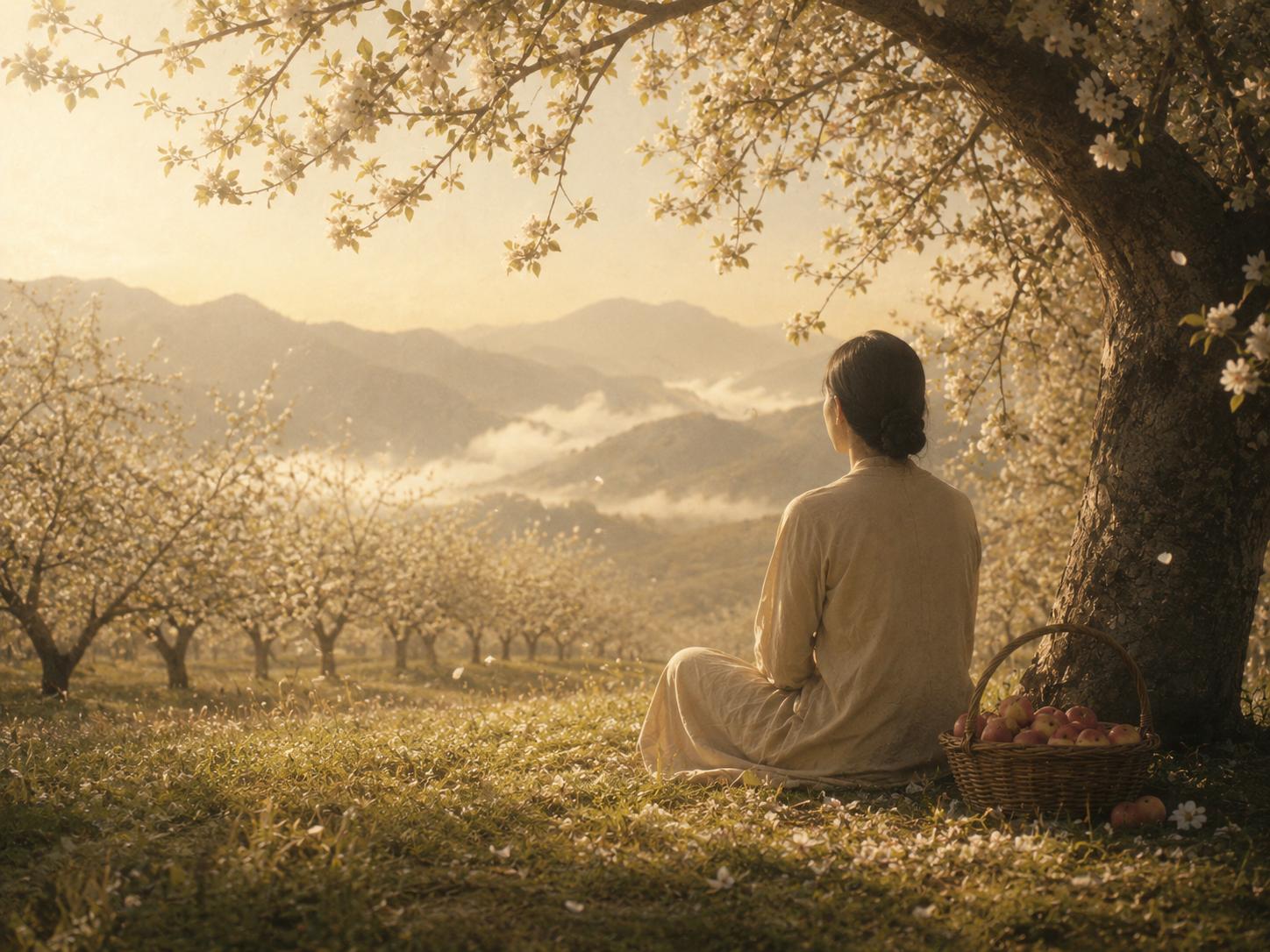
Return to Nature
An apple orchard is a place where a person can step away from the noise of everyday life and immerse themselves in natural harmony.
Here one can find solitude and calm, which are so often lacking in modern life. The rustling of leaves, the singing of birds, the fragrance of blossoming apple trees, the soft light and the shade of the trees help the body relax and gradually allow the inner self to open.
Make yourself comfortable on a bench in the shade of the trees. Allow yourself to do nothing. Simply observe. Listen to the movement of the air. Notice how the light changes. Feel how the body gradually releases its tension.
Nature does not demand immediate results from us. It does not force us to be productive, successful, or correct. It simply is present. And this very presence can become the first step toward returning to oneself.
Meditation Beneath an Apple Tree
An apple orchard is an ideal place for meditation practice.
Here it is easier to focus on the breath, calm the mind, and feel harmony with oneself. Leaves rustle in the wind, birds sing, branches move gently, and all of this gradually ceases to be an external background. It becomes part of the practice.
Begin simply:
- feel the body;
- bring attention to the breath;
- notice the sounds around you;
- look at the movement of the leaves;
- allow thoughts to come and go.
There is no need to drive thoughts away. There is no need to force yourself to become calm. It is enough to gently return attention to the breath, the body, and the orchard.
Imagine that you are becoming part of this natural symphony. With each inhalation and exhalation, you come a little closer to yourself — to your thoughts, feelings, body, and inner space.
Mindful Presence
Presence in the present moment is one of the central ideas of meditative practice.
To be present means to be where you are. Not to run away into the past, not to rush into the future, not to dissolve into anxiety and mental scenarios. This is not passivity and not a refusal to act. It is clarity.
Observe the apple trees. They change over time: awakening after winter sleep, opening their buds, becoming covered with blossoms, then green leaves, and later fruit.
Each stage comes in its own time. The tree does not hurry its flowering. It does not demand fruit from itself before the proper season. It simply follows the natural cycle.
In this we can see an important lesson: life unfolds gradually. Ripening requires time. Inner development cannot be accelerated by willpower alone.
Observing a tree, a person can feel harmony with the surrounding world and become aware of their place within it. They too are part of the natural cycle: breathing, growth, fatigue, renewal, flowering, and withering.
The Blossoming Apple Tree as an Image of Practice
A blossoming apple tree reminds us of the simplicity and depth of presence.
It does not explain itself. It does not prove its value. It does not strive to make an impression. Its beauty arises from naturalness.
That is why a flowering tree can become an object of meditation. Within it there is silence, rhythm, and the fullness of the moment.
One can look at a blossoming apple tree and ask oneself:
- What is awakening in me now?
- What requires time?
- What is already ready to unfold?
- What am I trying to accelerate?
- Where do I need more trust in the natural rhythm of life?
In this way, simple contemplation becomes not a rest from life, but a way to enter it more deeply.
Why Nature Is So Important to Us
Modern people often say that they need to “get out into nature,” “reset,” “breathe,” or “spend time in silence.” At first glance, this may seem like an ordinary need for rest.
But behind it there may be something deeper.
We need nature not only as a place to restore our strength. It reminds us of a world where everything is still connected with rhythm, cycle, embodiment, and immediate presence. In nature, a person can feel what is often lost in urban, digital, and technologized life: connection with the earth, time, the body, and the living process.
That is why returning to nature becomes not merely an aesthetic or ecological gesture. It can be a spiritual and existential movement.
A person returns to nature because they long for wholeness.
Longing for Paradise and Untouched Nature
Nostalgia for an Absent Centre
The modern person’s longing for paradise is not only a religious theme.
In traditional religious language, paradise could be associated with the Garden of Eden, with primordial harmony, with a world before division, anxiety, and loss. But in modern, secular, and technologized society, the direct religious reference often disappears.
Yet the longing itself does not disappear.
It is transformed into a deep, often unconscious psychological and existential phenomenon. It is a striving for wholeness, serenity, authenticity, perfect harmony, and inner peace in a world experienced as fragmented, alienated, and hyperreal.
Modern people intensely search for something, but they cannot always name the object of their search.
They seek peace, but find stimulation.
They seek authenticity, but encounter images.
They seek nature, but turn it into a product.
They seek themselves, but increasingly see only a reflection in digital mirrors.
This longing becomes a kind of “phantom limb” of the modern psyche: the lost paradise is absent, yet its absence is constantly felt.
Philosophical and Psychological Foundations
The concept of longing for paradise is rooted in philosophical anthropology, religious studies, psychoanalysis, and depth psychology.
Mircea Eliade spoke of homo religiosus as a human being oriented toward the sacred Centre. For traditional consciousness, the world is organized around a sacred point of reference. When this centre is lost, the person finds themselves in a space of dispersion and inner uncertainty.
Sigmund Freud saw in the striving for bliss, peace, and unity an echo of the unconscious desire to return to a state of primary security, closeness, and undifferentiated unity.
Carl Jung interpreted paradise as an archetype of the Self — an inner wholeness that becomes lost or hidden in the process of ego development. In this sense, the search for paradise can be understood as the search for the deep centre of the personality.
In the modern context, other ideas also become important.
Gilles Deleuze and Félix Guattari described capitalist society as a system that constantly produces desire but never allows it to be finally satisfied. Desire is continually redirected, stimulated, sold, and restarted. Therefore, the person lives in a state of permanent lack.
We may also speak of metaphysical nostalgia — a longing not for a specific past, but for a lost “homeland of being,” for a state in which a person would feel neither accidental, nor unnecessary, nor torn apart.
Manifestations of Longing for Paradise in Modern Culture
In the modern world, longing for paradise is rarely expressed directly. More often, it appears through compensatory practices, images, and cultural scenarios that promise to restore lost harmony.
The Cult of Nature and Eco-Utopianism
Paradise is often associated with untouched nature.
A forest, a garden, mountains, the sea, a village, a flowering tree, or a clean field become images of a world before damage, before industrial noise, before digital overload and social fragmentation.
From this arises the desire for a physical return “to the garden”:
- downshifting;
- moving to the countryside;
- life in nature;
- interest in farming;
- ecological settlements;
- retreats;
- practices of slowing down.
This also includes the fetishization of organic food, natural materials, ecological living, and a “natural” way of life. Naturalness begins to be perceived as purity before the Fall, where the role of sin is played by industrialization, pollution, and alienation from natural rhythm.
But there is a danger here: nature can become yet another commodity, another style of consumption, another image of an ideal life. Then a person does not return to nature, but buys its symbols.
Apocalyptic Narratives
Apocalyptic and post-apocalyptic plots in art are often the reverse side of longing for paradise.
If the modern world is perceived as spoiled, artificial, and overloaded, a fantasy of purification arises. In order to return to a “pure” state, the world must pass through destruction.
The post-apocalypse often shows not only fear of the end, but also a secret desire to begin again. After catastrophe, old institutions, cities, systems, roles, and social masks disappear. What remains is the human being, the earth, the sky, fire, water, food, community, and the question of survival.
In this sense, the end of the world becomes a distorted image of returning to the beginning.
Techno-Utopianism and Digital Paradise
Paradoxically, longing for paradise is projected not only into the past or into nature, but also into the future — into the sphere of technology.
Transhumanist projects promise the overcoming of aging, illness, bodily limitations, and, in their ultimate form, death. This is an attempt to create a new Eden with human hands — through science, technology, and control over nature.
Virtual realities and metaverses offer a designed, controlled paradise without pain and without the limitations of the physical world. In such spaces, one can create a new identity, a new body, a new home, new rules, and a new destiny.
Social networks become a space for curating an ideal “self” and an ideal life. A person creates a personal paradisiacal narrative for the external observer: beautiful places, happy moments, correct thoughts, clean interiors, spiritual practices, success, and harmony.
But this digital paradise remains fragile. The more perfect the created image, the more painful the gap between image and real life becomes.
Consumerism as a Search for Edenic Abundance
Consumerism can also be seen as a form of longing for paradise.
Endless shopping, the cult of new things, the search for the perfect home, perfect clothes, perfect body, perfect holiday — all of these are attempts to approach a state of fullness through possession.
Every purchase becomes a small promise of a new beginning. It seems that the next thing will bring completion, coherence, beauty, status, or peace.
But this promise quickly dissolves. Desire returns again, because a thing cannot fill an existential emptiness.
Thus paradise turns into a shop window, a shopping cart, and an endless succession of images.
Psychoculture and the Cult of Mindfulness
Modern people increasingly search for paradise within themselves.
Meditation, mindfulness, yoga, breathing practices, body therapy, retreats, and psychotherapy promise a return to inner peace. There is genuine value in this, but there is also the risk of turning spiritual practice into yet another form of consumption.
Mindfulness can be a path to clarity. But it can also become a commodity if it is sold as a quick way to eliminate anxiety, increase efficiency, and become a more successful version of oneself.
Psychotherapy often works with trauma as an experience of “expulsion from the paradise” of childhood safety. The goal becomes integration — inner wholeness, which in psychological language partly corresponds to the image of the lost paradise.
But genuine inner work begins not with the promise of perfect peace, but with the willingness to meet what is.
Nostalgia for a Golden Age
Longing for paradise also manifests as nostalgia for a “golden age.”
In politics, this can be seen in slogans about returning to former greatness. Such slogans often exploit longing for the lost paradise of national, cultural, or social identity.
In art and design, it appears in the aesthetics of vintage, retro, wear, old objects, and pre-digital forms. The shabby chic style, retro interiors, film photography, interest in old letters, books, and handmade work — all of this can be an attempt to regain warmth and authenticity in the past.
Here, the past becomes not historical reality, but an image of lost wholeness.
Fantasy and Neo-Mythology
The boom in fantasy and neo-mythology is another manifestation of longing for a whole world.
From Tolkien to modern game universes, we see the creation of alternative worlds where there are clear laws of good and evil, destinies, trials, heroes, a path, mentors, magic, ancient texts, and sacred territories.
In the complex modern world, where meanings are blurred, such worlds provide a sense of structure. They offer a map that is often missing in reality.
Fantasy becomes not merely entertainment, but a way to experience longing for a mythological cosmos in which the human being once again has a place within a greater order.
When Longing Becomes Pathological
In extreme forms, longing for paradise can take destructive shapes.
FOMO and the Depression of Comparison
The fear of missing out arises when a person feels that real life is happening somewhere else.
On social networks, they see someone else’s “paradise”: travel, relationships, beauty, success, spirituality, perfect breakfasts, harmonious families, productivity, and freedom.
Gradually, a feeling emerges that paradise belongs to others, but not to oneself.
Thus anxiety, envy, fatigue, and a sense of personal insufficiency are born.
Perfectionism and Procrastination
Longing for an ideal state can turn into perfectionism.
A person does not begin a task because the result must be flawless. The project remains pure and beautiful only as long as it has not been realized. A blank page seems safer than imperfect action.
Thus arises the fear of “defiling” the idea through real execution.
The paradise of the unfinished project remains untouched, but for that very reason it never becomes alive.
Escapism and Addictions
Another form is escape into addictions: gaming, chemical, serial, digital, emotional.
Addiction promises a state of carelessness, oblivion, and temporary liberation from pain. It is a surrogate paradise that does not heal, but temporarily switches off the experience of fragmentation.
But after the return, reality seems even heavier, and the cycle repeats.
Examples in Contemporary Literature and Cinema
Metro 2033
Dmitry Glukhovsky’s Metro 2033 series of books and games presents a post-apocalyptic world as a space after expulsion from paradise.
The characters long not simply for the past. They long for a lost normality: a clear sky, safety, the surface, light, the familiar world, which has now become almost a myth.
Here paradise is not a religious place, but the memory of the world before catastrophe.
Ex Machina
The film Ex Machina (2014) can be read as a story about an artificially created paradise.
Nathan’s house is an isolated, technologically perfect space, resembling a modern Eden. In it, a human being plays the role of God by creating artificial intelligence.
But Ava, created in this controlled paradise, strives for freedom. The film shows that even artificial perfection can be a prison if there is no authenticity and freedom within it.
Submission
In Michel Houellebecq’s novel Submission, the protagonist, an apathetic intellectual, experiences longing for the lost cultural, social, and sexual “paradise” of Europe.
His search for consolation becomes an attempt to find a new order that promises peace, meaning, and deliverance from inner emptiness. Even if this order proves disturbing and ambiguous.
Here longing for paradise becomes not only a personal but also a political phenomenon.
Conclusion: Longing as Driving Force and Dead End
The modern person’s longing for paradise is an affect deprived of a concrete object.
It drives progress because it compels the human being to create a better world. But it also feeds regression because it makes one dream of returning to a mythical past.
It can be a source of art, philosophy, spiritual search, and inner work. But it can also become a source of anxiety, comparison, consumption, addiction, and endless dissatisfaction with the present.
In a secular world, this longing cannot be finally satisfied, because its religious resolution has often been rejected or forgotten. Therefore, it expresses itself in endless simulacra:
- in the purchase of a “paradise vacation”;
- in the search for ideal relationships;
- in the striving for a pure body;
- in the attempt to create a clear mind;
- in the digital image of an ideal life;
- in the dream of untouched nature;
- in the desire to return to a lost golden age.
Modern human beings become eternal exiles, carrying the projection of a lost paradise within themselves and trying to find it outside.
But the external world is changeable, imperfect, and material. It cannot fully correspond to the image of paradise. And that is precisely why the attempt to find absolute wholeness only in external forms is doomed to disappointment.
This longing is not an illness. Rather, it is a symptom of the human condition. A sign that the human being is torn between the memory of wholeness — real or imagined — and the experience of finitude, imperfection, and choice.
Its overcoming lies not in finding paradise as a ready-made place, but in the courage to accept one’s exile as a condition of freedom and creation.
In this sense, the apple orchard does not return us to paradise.
It does something more important.
It reminds us that the path to wholeness begins not somewhere far away, but here:
in breathing,
in silence,
in a flowering tree,
in the ability to look,
to listen,
to wait
and to be present.