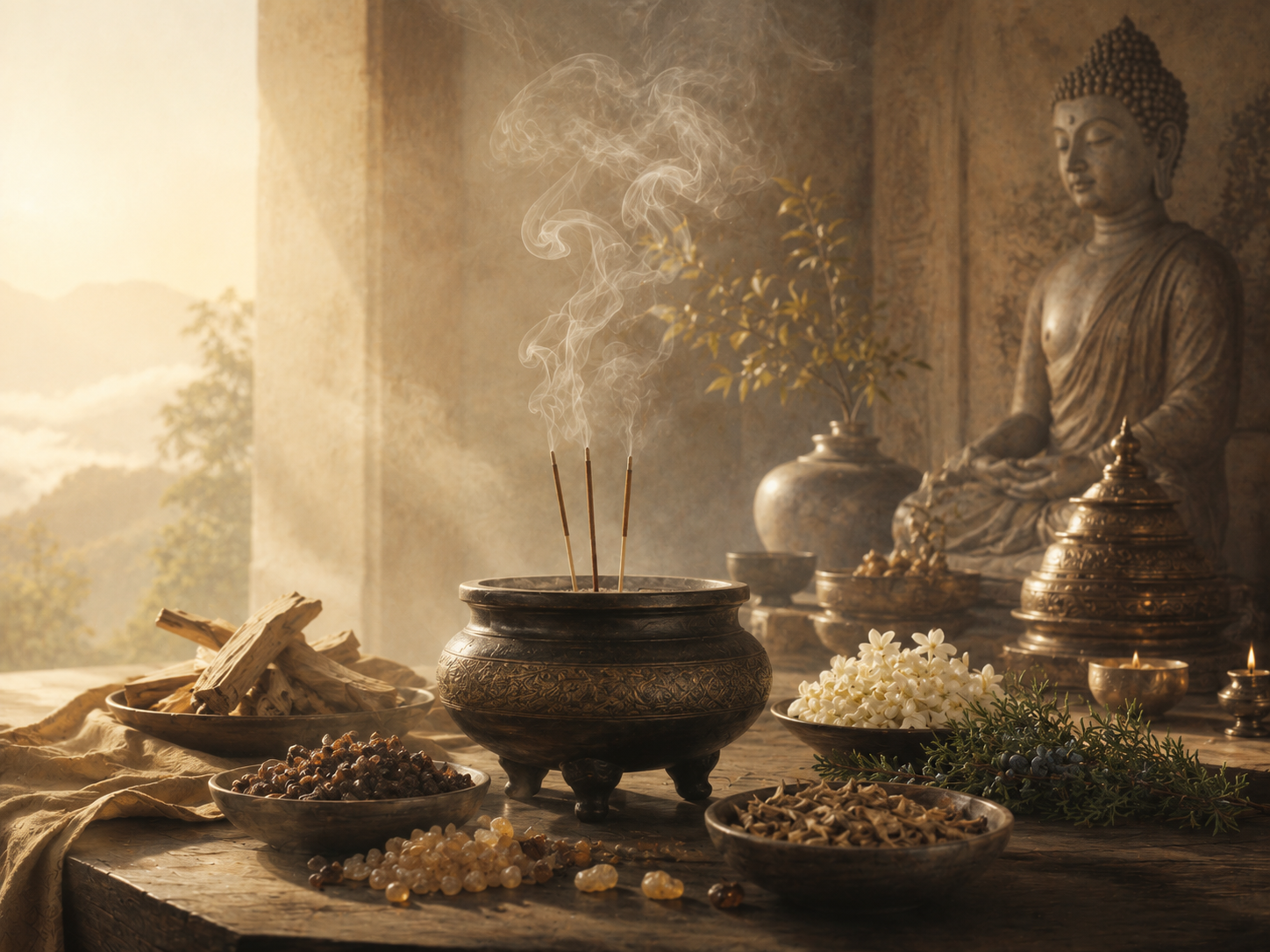
Aromas of Dharma
“The fragrance of sandalwood, tagara, and jasmine does not travel against the wind. But the fragrance of the virtuous travels against the wind. The virtuous person spreads fragrance in all directions.”
— Dhammapada
Human beings seek beauty through all the senses. We contemplate the colours of an evening sky, listen to rain or birdsong, and feel tenderness in touch. Yet the world is also filled with millions of aromas. Without them, our sense of life and reality would not be complete.
Scent, memory, and states of mind
Smells affect us more deeply than we usually think. The sense of smell gives us fewer “data” than sight or hearing, but it is more closely connected with memory and emotion.
Signals of smell are directly linked to the limbic system, the areas of the brain related to emotion, memory, and reaction. That is why smells can call up vivid memories, change an emotional state almost instantly, and create the atmosphere of a place.
Smells are processed by structures connected with the amygdala and hippocampus. These areas participate in emotional memory. A faint scent can suddenly return the feeling of childhood, recall a precise place, or awaken a state that is difficult to describe in words. This is often called the Proust effect.
Although people often consider smell a weak sense, research shows that we can distinguish an enormous number of scent combinations. Modern culture simply rarely teaches us to live attentively through smell.
Incense as practice
In Buddhist culture, fragrance is not merely decoration. Incense purifies the atmosphere, helps the mind gather itself, and marks the transition from ordinary time to the time of practice. It creates a subtle boundary: here, attention begins.
Sandalwood, juniper, jasmine, agarwood, wormwood, lotus, and myrrh each carry their own tone. One calms, another clarifies, another recalls a monastery courtyard, a text, a prayer, or the presence of a teacher.
When fragrance rises into the air, it disappears and fills the space at the same time. In this there is an image of practice itself: it cannot be grasped roughly, yet it changes the quality of presence.
The fragrance of virtue
The Dhammapada says that ordinary fragrance does not travel against the wind, but the fragrance of a virtuous person travels in every direction. This is not poetic exaggeration, but a precise indication of the nature of action.
True virtue does not need to display itself. It changes the space around a person as quietly as a subtle scent changes a room. We may not immediately name what has changed, but we feel it: near such a person it is easier to breathe and easier to remember what matters.
The practice of subtle perception
The aromas of Dharma teach attentiveness. They return us to the body, breath, memory, and space. They remind us that practice does not happen only in thought. It touches sight, hearing, skin, breathing, and smell.
To light incense is not simply to fill a room with a pleasant fragrance. It can be a small vow of presence: I stop, I remember, I create a space in which the mind can be seen more clearly.
Thus fragrance becomes not an external detail, but part of the path. It disappears, yet leaves a trace: like a teacher’s word, a gesture of kindness, or a moment of clear attention.